

- door Ursus Negenborn
Sling Bag vs Backpack: Which Carries Better for Movement?
- door Ursus Negenborn
The sling bag vs backpack question often comes down to a simple thing: how much do you actually move during your day. Both styles keep your hands free. Both can carry a meaningful load. The real difference shows up when you start walking long stretches, cycling, navigating crowds, or moving through a busy travel day. The way each bag sits on your body either supports that movement or quietly fights against it.
This guide breaks down what each style does well when you are actively on the move and helps you decide which option makes the most sense for your everyday carry, travel, or outdoor adventures.
To anchor the comparison, here are two representative Nanobag models, the Sling (crossbody) and the Daypack (zippered backpack), with specifications taken directly from the official Nanobag product page.
|
Feature |
Nanobag Sling (Crossbody) |
Nanobag Daypack (Backpack) |
|
Style |
Single-strap Crossbody |
Two-strap Zippered Backpack |
|
Volume |
19L |
16L |
|
Weight |
0.90 oz |
1.15 oz |
|
Packed Size |
3" × 2" × 1" |
3.5" × 2" × 1" |
|
Unpacked Size |
17" × 16" |
14" × 18" |
|
Strap |
20" reinforced crossbody strap |
27" wide backpack straps |
|
YKK Zipper |
No |
Yes |
|
Load Capacity |
66 lb |
66 lb |
Both models share the same custom diamond ripstop fabric, PFC-free water-repellent coating, bartack reinforcement at every stress point, and the same 66 lb load capacity. The differences come down to how each one sits on your body when you move.

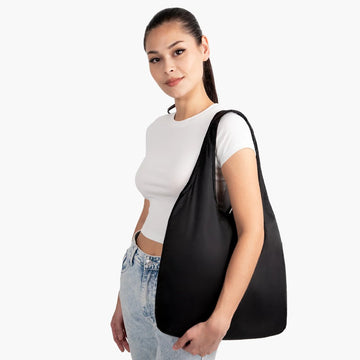
A sling uses a single strap that runs diagonally across your torso. The carry sits close to your body and the weight rests on one shoulder and your opposite hip. That single point of contact is what gives a sling its defining quality: stability during movement. The bag does not bounce, swing, or shift the way a tote handle would, even when you are walking quickly, ducking through a crowd, or cycling through traffic.
Quick access is the other thing a sling does well. The bag can swing forward across your front without taking it off, so you can reach into it for keys, a phone, or a metro card without breaking stride. For days built around frequent stops and starts, that fast-access design saves real time.
Best for: City commuting, sightseeing, market days, airport navigation, and any routine where you are moving constantly and want both hands free without the formality of a full backpack carry.

A backpack uses two straps over both shoulders, with the weight spread evenly across your back rather than along one diagonal. That two-strap distribution is what makes a backpack the more comfortable choice once you start wearing the bag for hours at a time or once the load starts to climb past a few pounds. Where a sling concentrates the weight, a backpack shares it.
The Nanobag lineup includes two backpack options. The Daypack uses a full YKK zipper and wide 27-inch straps designed for all-day wear, which makes it the natural choice for longer commutes, day hikes, and sightseeing days that run from morning to evening. The Pack uses a drawstring closure and a 31-inch cinch strap, which suits more active use where speed of access matters and the load is a little lighter.
Best for: Longer commutes, hiking, transit-heavy travel days, and any routine where comfort over distance matters more than fast access.
Stability during movement: A sling stays glued to your body because the strap pulls it in close. A backpack stays balanced across your back because the two straps share the load. Both are stable, in different ways. A sling is more stable for short sharp movements like cycling or weaving through a crowd. A backpack is more stable for sustained motion like walking or hiking.
Access speed: A sling can swing forward to your front without coming off. A backpack has to come off at least one shoulder for full access. For bags opened often during the day, a sling is faster. For bags worn for hours and opened a few times, a backpack is fine.
Weight distribution: A sling concentrates the load on one shoulder and the opposite hip. A backpack spreads it across both shoulders. For loads under five or six pounds and shorter wear, the difference is small. For heavier loads or longer wear, the backpack becomes more comfortable.
Carry style on the body: A sling reads relaxed and active. A backpack reads more structured and intentional. The sling works in casual contexts and quick urban settings. The backpack fits longer commutes, outdoor days, and more equipment-heavy use.
Security: The Sling uses an open-top format for fast access. The Daypack uses a full YKK zipper for moments when you want belongings kept in place, like crowded transit or busy travel days.
Choose a sling if your day is built around fast movement and frequent access. City commutes, cycling, sightseeing, market trips, airport navigation, and casual outings all suit the format. The 19L Nanobag Sling carries a typical daily load comfortably while keeping both hands free and the bag close to your body.
Choose a backpack if your day involves longer wear, heavier loads, or extended walking. Commutes that involve real distance, day hikes, full sightseeing days, or trips where you want zippered security all suit the two-strap format. The 16L Nanobag Daypack covers structured days with a YKK zipper.
If you cannot decide, there is a real case for owning both. Every Nanobag packs into an attached integrated pouch small enough to fit in any pocket. Carrying a sling and a backpack option costs almost nothing in space and means you always have the right bag for the kind of day you are actually having. You can compare every model in the Nanobag size guide.
Independent recognition counts for more than any claim a brand makes about itself. The Nanobag Daypack earned a spot in Mrwhosetheboss's Best Tiny Tech feature, recognized for folding into a pocket-sized pouch while expanding into a durable 16L backpack with a carrying capacity of up to 66 lb. BuzzFeed editors also picked the Nanobag for their February 2026 Tested & Loved roundup. The lineup has also been featured by Pack Hacker, Yanko Design, The Grommet, and Forbes among other publications, each highlighting different angles of the design.
Beyond the press, over 200,000 customers carry Nanobags worldwide. The verdict that matters most for a sling versus a backpack is whether the bag feels right at the end of a full day of movement. A bag that disappears into the rhythm of your day is the one that earns its place in your routine.
Delen:
How to Choose the Best Tote Bag for Work
How to Choose the Best Day Hiking Backpack