
- par Ursus Negenborn
How to Choose the Best Personal Item Bag
- par Ursus Negenborn
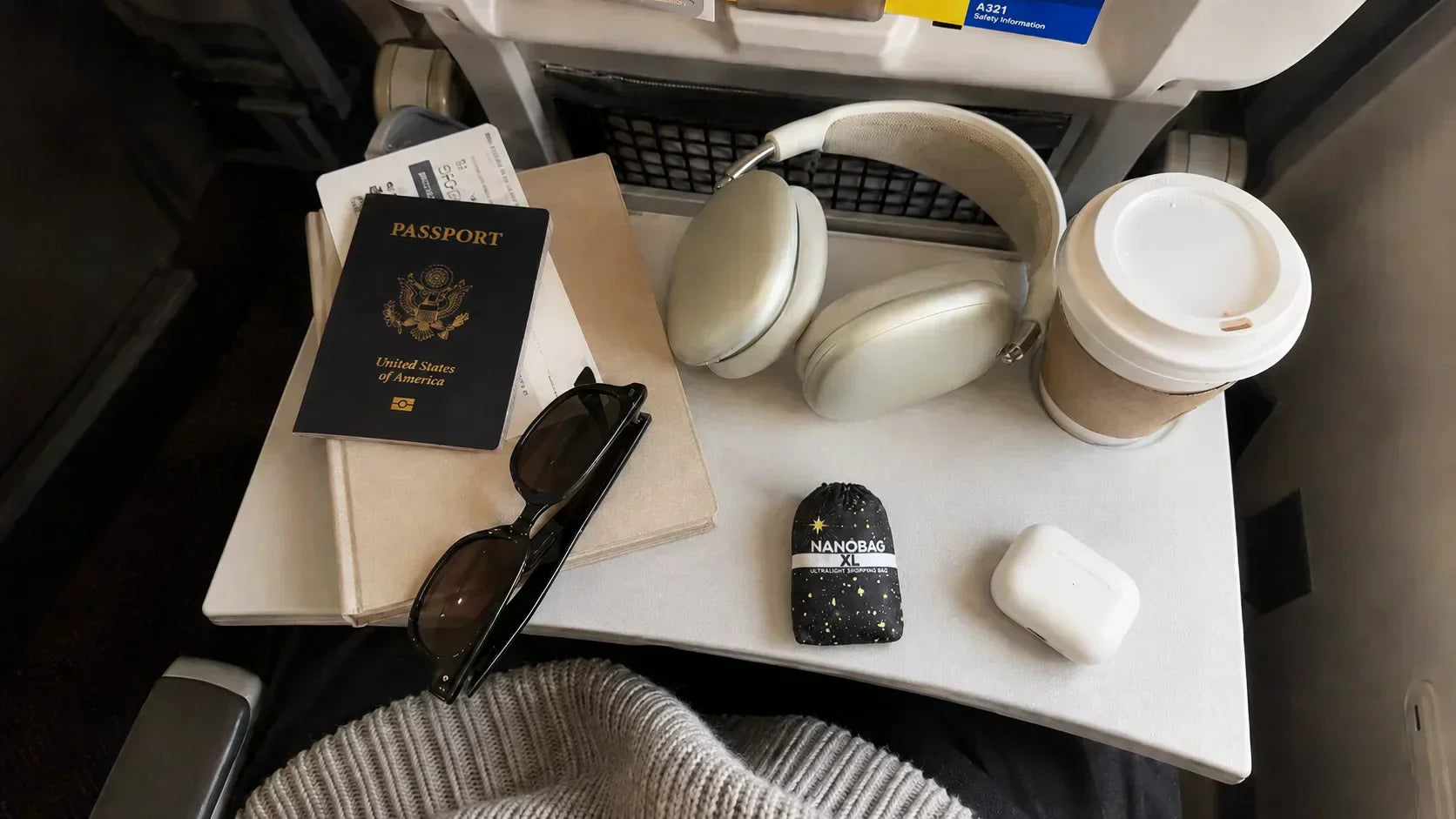
Every airline ticket comes with two bags. One carry-on for the overhead bin, and one personal item, the smaller bag that fits under the seat in front of you on the plane. Most travelers rely on whatever backpack or tote they already own, then leave it in the hotel room once they arrive. Choosing the best personal item bag changes that entirely. The right one does double duty as your personal carry on bag during the flight and a day bag at your destination, which makes it one of the most useful pieces of gear you can pack.
There are a lot of options marketed as personal item travel bags, and ranking them is not the point of this guide. Instead, this is a clear breakdown of what a great personal item bag actually has to do, so you can judge any option against the same standard. By the end, you will know what to look for and which Nanobag size and style fits the way you fly.
A personal item bag is the under-seat bag that travels with you on the plane. The best personal item bags do double duty: they hold your in-flight essentials and become a day bag at the destination. These are the features that separate one worth bringing from one you regret choosing.
Personal item dimensions vary by airline, but a useful rule of thumb is around 18 x 14 x 8 inches or smaller. The bag must fit under the seat in front of you. Anything larger risks being gate-checked or counted as your main carry-on. Softer, packable bags work to your advantage here because they conform to the under-seat space rather than fighting it.
During the flight, the bag sits at your feet. You will reach into it dozens of times for headphones, a charger, a snack, a passport, or a book. The right kind of access matters. A bag that opens wide, zips fully along the top, or uses a simple drawstring is faster to dig through than one that requires fishing past awkward compartments.
Budget carriers, especially internationally, weigh both your carry-on and personal item. Even where weight is not strictly enforced, a heavy empty bag means more strain across a long travel day. The lighter the bag is on its own, the more of your weight allowance goes to what you are actually carrying.
This is what makes a personal item worth thinking carefully about. The bag does not need to stay in your hotel room once you arrive. The best personal item bags are the ones you actually want to use for a city day, a market trip, or a sightseeing walk. A bag that pulls double duty earns its place in two ways instead of one.
Some days you will not need a separate bag at the destination. On those days, a packable personal item disappears inside your main luggage instead of taking up room or filling a hotel closet. A truly compact personal pocket bag that folds away when not in use pays off across the entire trip, not just on the plane.
Travel days are long. A bag that is comfortable for the first hour but punishing by hour six is not worth bringing. Look at how the weight will sit on your body across terminals, transit, and sightseeing. Wider straps, crossbody designs, and layered handles all distribute weight differently.
Here is how Nanobag was built to meet each point as a personal item bag:
Personal item fit: Every Nanobag model unpacks well within standard airline personal item dimensions. The largest, the XL, opens to 20 x 17 inches and is soft enough to conform to the under-seat space. None of the models come close to the limit, so they all fit comfortably with room to spare.
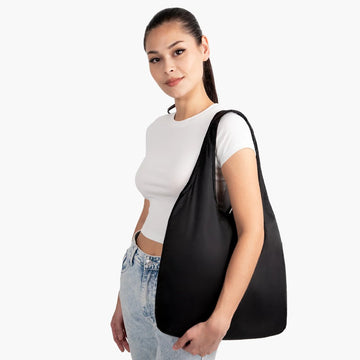
In-flight access: Tote models like the Standard, Micro, and XL have an open top for fast access during the flight. The Daypack uses a full YKK zipper for secured access between uses, the Pack uses a drawstring closure, and the Sling stays close to your body during boarding and disembarking with its crossbody strap.
Genuine lightness: Every Nanobag weighs between 0.80 oz and 1.15 oz. Even the heaviest model adds almost nothing to your carry-on weight, leaving the full allowance for what you are actually packing.
Doubles as a day bag: This is where Nanobag stands apart. Every model is designed to be a real day bag at the destination, not just an in-flight container. Use it during the flight, then carry it through the city, to the beach, or out for groceries.
Packs to pocket size: Every Nanobag folds into an attached integrated pouch small enough to fit in any pocket. When you do not need it as a separate bag, it disappears inside your main luggage. No closet space required.
Strength and weather resistance: Every Nanobag carries up to 66 lb and uses bartack reinforcement at every stress point. The PFC-free water-repellent coating keeps your items dry, and prevents dust and particles from sticking to your bag.
Comfort: Nanobag tote models feature triple-layered handles for hand or shoulder carry. The Sling uses a 20-inch reinforced crossbody strap that keeps both hands free across long travel days. The Daypack uses wide backpack straps designed for all-day wear.

It comes down to how you fly and what you want to do at the destination. For hands-free in-flight carry and city days once you land, the 19L Sling is the natural fit. If you want a personal item backpack with structure and a zipper for secured access, the 16L Daypack is built around that. The 14L Pack offers another backpack option with a drawstring closure for active days. For overflow capacity, market hauls, or beach days, the 25L XL gives you room. The 19L Standard is the versatile tote option, and the 12L Micro works as a minimalist secondary bag when you want the lightest possible carry. You can compare every option in the travel bags collection.
If you are not sure which one suits you, the Nanobag size guide walks through every model with real capacity examples. For the full picture on how to pack a personal item alongside your main carry-on, the carry-on packing guide covers the rules, the packing method, and where the personal item fits into the whole travel kit.
Independent recognition counts for more than any claim a brand makes about itself. The Nanobag Standard was named Best Tote in Nomads Nation's 2025 Power Rankings, chosen for packing smaller than competing totes while still carrying a full load. Yanko Design also featured the Nanobag Daypack as an ultra-compact full-size backpack that folds down to the size of a flip phone, exactly the kind of packability that defines a great personal item bag.
Beyond the press, over 200,000 customers carry Nanobags around the world. The verdict that matters most for a personal item specifically is whether it still feels right at the end of a long flight and a long first day at the destination. A bag light enough to barely be felt, and packable enough to vanish when not in use, is the one that earns its place under the seat.
The best personal item bag is the one that works during the flight and earns its place at the destination. The surest way to choose is to match the bag to how you fly and what you actually do once you land. Measure any option against the criteria here, fit, access, weight, doubled use, packability, and comfort, and you will know what to look for. When you are ready to choose, you can check out all the models in the travel bags collection.
Partager:
How to Choose the Best Foldable Bag for Daily Use
Tote vs Backpack: Which One Is Right for Daily Use