
- I18n Error: Missing interpolation value "Author" for "Af {{ Author }}"
Why Your Grocery Bag Should Fit in Your Pocket
- I18n Error: Missing interpolation value "Author" for "Af {{ Author }}"
Most people already own a reusable grocery bag. The problem is that most of those bags are at home in a drawer, in the trunk of the car, or hung on a hook by the front door when the trip to the store actually happens. The bag exists. It just is not where you are. That gap between owning a reusable grocery bag and having one on you is where a packable grocery bag earns its place.
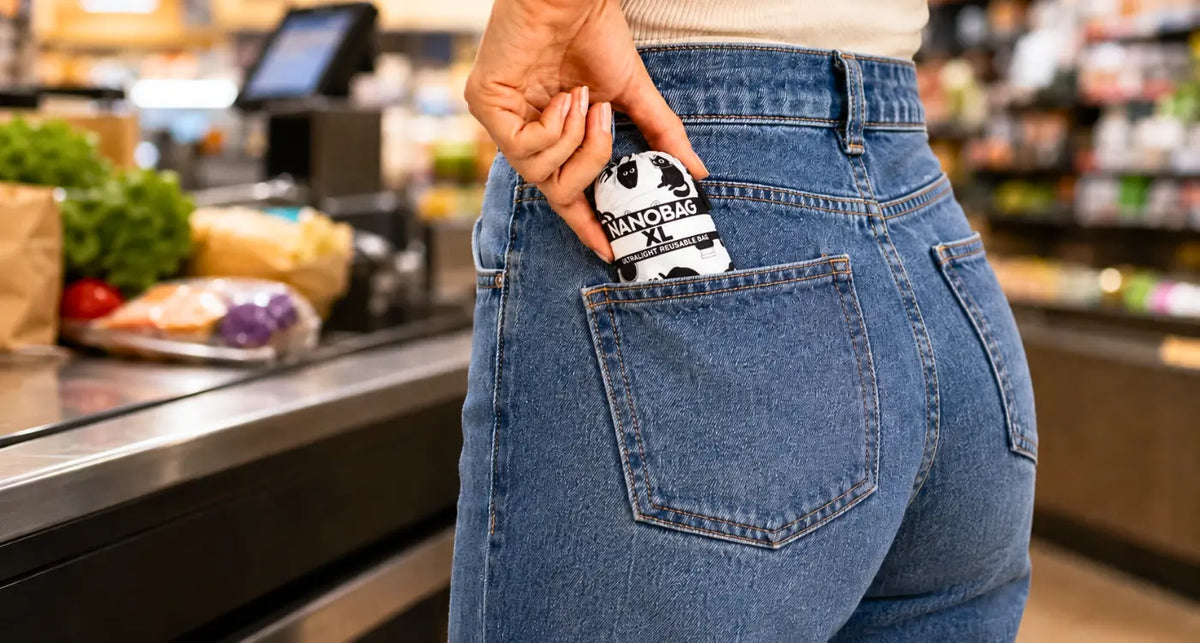
A grocery bag that fits in your pocket solves the forgetting problem in a way a folded canvas tote never can. When the bag lives with you, on your keychain or in a pocket, it stops being something you have to remember. It is just there.
This guide breaks down what makes a grocery bag actually pocket-sized, why lightweight matters more than most people think, and how the compact format changes shopping in ways you notice from the first week.
Most reusable grocery bags fail because they aren't available when you need them, not because of any particular specification. A canvas tote can easily carry 20 lb (9 kg) of groceries, but if it's sitting at home when you decide to stop by the store on your way back from work, it might as well not exist. A bag is only useful when you have it with you.
The category has spent years trying to solve this problem with bags that have clips, bags that fold flat, and bags that stuff into a small stuff sack. Most of these were only half-solutions because the folded bag was still too bulky to actually live in a pocket, the stuff sack was easy to lose, or the folding technique required more attention than anyone gives a bag at the checkout.
A genuinely packable grocery bag is one that lives in a pocket without you noticing it is there. Once the bag stops taking up meaningful space, the calculus of always having one changes completely.
Not every bag that claims to pack down is actually pocket-friendly. Three things separate a bag that lives in a pocket from a bag that lives in a drawer.
A bag that comes with a separate pouch usually loses it within a month. It needs to be sewn to the bag itself, so packing it away is a one-motion task and there is no small piece of fabric to lose. An integrated pouch is the difference between a bag you keep pocket-ready and a bag you gradually stop using.
Bags that require a specific folding technique to fit in their pouch eventually stop getting packed. Whoever is packing at the end of the shop is tired, has other things to do, and will not spend two minutes lining up creases. A fabric engineered to eliminate air pockets and compress without folding, combined with a pouch that lets the bag stuff away in a single motion, creates a format that takes up minimal space and holds up to repeated use.
A pocket sized grocery bag needs to be light enough that you do not feel it when you carry it around all day. Lightweight grocery bags in the 0.7 to 1.2 oz (20 to 35 g) range disappear into any pocket. Anything heavier and the bag stops being carry-anywhere.
The reason lightweight matters is behavioral, not aesthetic. A bag you have to consciously carry gets forgotten. A bag you can barely feel in your pocket becomes the background, and background objects are the ones that are always with you when you need them.
The heaviest reusable grocery bags on the market weigh 5 to 10 oz (150 to 300 g) empty. A canvas tote might come in at 3.5 to 9 oz (100 to 250 g) before you add a single item. A compact grocery bag in ripstop nylon can weigh 0.7 to 1.2 oz (20 to 35 g) empty and hold the same shopping load. The empty weight difference does not matter if the bag lives in your car. It matters a lot if the bag lives on you.
The behavioral shift happens fast. Within a week of carrying a packable grocery bag on you full-time, two things change.
Unplanned stops become plastic-free by default: The impulse grocery run, the after-work pickup, the moment you decide you need milk on the way home. All the shops that would normally have you reaching for a plastic bag at the checkout are covered because the bag was already with you.
You end up needing fewer bags overall: Most households own six or seven forgotten reusable bags stacked in a drawer somewhere. A single pocket-sized bag that lives on you replaces most of them because it is the one that is actually present at the checkout.

Every model in the Nanobag reusable grocery bags collection is built around this exact problem. Each Nanobag stuffs into an attached integrated pouch that fits in any pocket, weighs between 0.80 oz and 1.15 oz (22 to 33 g) depending on the model, and carries up to 66 lb (30 kg). The soft custom diamond ripstop nylon eliminates air pockets naturally, so packing the bag back into the pouch takes seconds without any folding technique.
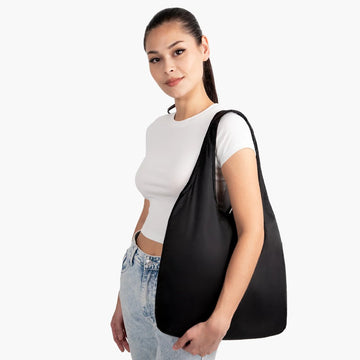
The 19L Standard is the natural choice for a regular grocery shop, matching the volume of a normal supermarket run. The 25L XL handles bigger weekly hauls or farmers market days. The 12L Micro is the lightest option for daily top-ups. The 19L Sling adds a crossbody strap for hands-free carry from the store to home. For grocery hauls that involve longer walks or public transport, the 14L Pack (drawstring closure) and the 16L Daypack (YKK zipper) both work as backpack alternatives with hands-free carry across both shoulders. All six sit comfortably in any pocket when packed, and all six handle the load ratings a real grocery shop demands.
For a deeper look at how much reusable bags can actually hold, the guide to reusable bag weight capacity covers the material and construction factors that determine safe load.
The best grocery bag is the one you have on you. A packable grocery bag that fits in your pocket removes the forgetting problem from the reusable bag equation, and everything downstream of that changes. Fewer plastic bags at unplanned stops, fewer unused totes in the drawer, and one bag that consistently earns its place. When you are ready to choose, you can see all the compact models in the reusable grocery bags collection.
Del:
How to Choose the Best Reusable Shopping Bag
Why Every Traveler Needs a Packable Bag