
- scritto da Ursus Negenborn
How to Choose the Best Reusable Shopping Bag
- scritto da Ursus Negenborn
The best reusable shopping bag is the one that fits how you actually shop, not the one that looks best in the promotional photos. A bag that works for someone who drives to the store once a week is different from the bag that works for someone who walks to the corner shop three times a day.
This guide walks through the criteria that actually matter when choosing a bag, the mistakes first-time buyers make, and how to match the format to your shopping habits so you end up with one bag you use every day rather than ten bags in a drawer.
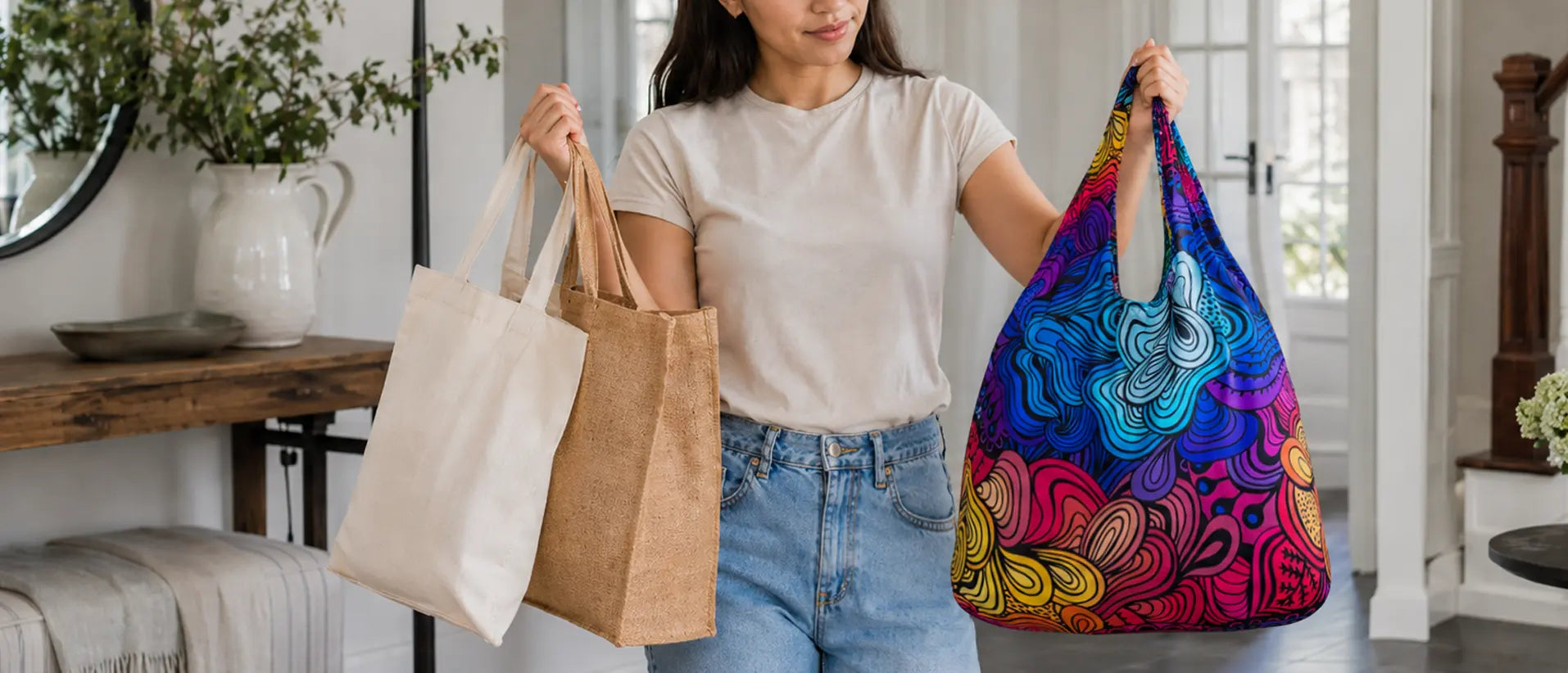
Until recently, the reusable bag category was dominated by heavy cotton totes and jute bags that were durable but bulky. They worked at the store and failed everywhere else. Most shoppers ended up with a collection of these bags stashed in the car or by the front door, and defaulted to plastic when the reusable bag was not with them.
The category has genuinely improved in the last few years. New materials, better construction, and lighter fabrics have created a new class of packable reusable bags that fold small enough to travel with you between trips. Choosing the right one now means knowing what to look for in this newer format, not just picking the biggest tote at the checkout counter.
Five things separate a bag that lasts for years of daily use from a bag that gets used twice and stuffed in a drawer. Look at each of these before you buy, and the choice becomes much clearer.
The fabric determines how much the bag weighs, how much it can carry, and how long it lasts. Cotton canvas is durable but heavy and absorbs water. Jute is naturally strong but bulky and does not compress. Plain-weave polyester is cheap but often fails at the seams within a season. Ripstop polyester exists and holds up better than plain-weave polyester, but it still trails ripstop nylon on strength and abrasion resistance. Ripstop nylon is the lightest and strongest option in the category thanks to its engineered ripstop weave, and it is the fabric used in the best-engineered packable bags.
The published load rating tells you what the bag can safely carry without failing at the seams or handles. Cheap foldable bags typically handle 15 to 35 lb. Well-made cotton totes handle 20 to 40 lb. The strongest packable bags with reinforced construction can carry over 60 lb. For a full breakdown of how load ratings work across materials and constructions, see the guide to how much weight reusable bags can hold.
If the bag is not with you when you need it, it does not matter how strong it is. This is why the packable format has come to dominate the higher end of the category. A bag that folds into a pocket-sized pouch travels with you between trips, so it is actually with you when you need it. Look for a bag with an attached pouch, not a separate one that gets lost, and check whether the bag actually compresses small enough to fit in a pocket or purse.
Fabric matters, but the construction determines whether the bag holds up over years of use. Look at three specific things: reinforced stitching at handle attachments (usually visible as a dense box or rectangle pattern where the straps meet the body), double-stitched seams along the base and edges, and a published construction detail like bartack reinforcement at every stress point. Bags without visible reinforcement usually fail at the handles first.
The best bag for daily use should be easy to clean, especially if you use it for groceries. Check whether the material can be hand washed with mild soap and how long it takes to dry. Cotton takes a full day to dry after washing. Ripstop nylon with a water-repellent coating dries in a couple of hours.
Different shoppers need different bags. The framework below matches the format to the use case.
For daily errands and grocery runs: You want a packable bag that folds small enough to always be with you. Load capacity in the 40 to 65 lb range covers most weekly grocery runs. A tote design with 12 to 25 liters of volume handles the mix of quick corner-store stops and full weekly hauls.
For farmers markets and heavier hauls: You need higher volume, typically 20 to 25 liters, and a load rating that handles heavier produce and dense items like jars and preserved goods. Look for reinforced base seams because farmers market items concentrate weight at the bottom of the bag.
For hands-free carry across town: A sling or crossbody design distributes weight across the shoulder and leaves your hands free. This is the format that works for shoppers walking or cycling between stops. Volume in the 15 to 20 liter range is usually right for this use case.
For commuting and travel: A backpack format spreads weight across both shoulders for longer walks, cycling commutes, or travel days. Look for closure options like drawstrings for quick access or zippers with quality hardware for secured carry.
Three mistakes account for most of the reusable bags that end up unused in drawers.
Buying the biggest bag available: A 30-liter tote sounds like it covers every use case, but the extra bulk means the bag lives in the car or by the door instead of in a pocket. A bag perfectly suited to what you’re likely to carry gets used far more often than a big bag that stays home.
Choosing based on price alone: Cheap foldable bags handle a season or two of light use before the handles or seams fail. The per-trip cost of a bag that lasts three months is much higher than the per-trip cost of a well-made bag that lasts three years, even if the upfront price is higher.
Ignoring the closure and pouch design: A packable bag without an attached pouch is a bag you will lose the pouch to within a month. Look for an integrated pouch that stays with the bag, so folding it back down is a five-second job instead of a lost-pouch problem.
Nanobag was designed specifically around the five criteria above. Every bag in the Nanobag lineup uses custom diamond ripstop nylon at 0.05mm thickness with a PFC-free water-repellent coating. Every model has bartack reinforcement at every stress point, double-stitched piping along the seams, and an attached pouch that stays with the bag. Every model carries a 66 lb (30 kg) load rating.
The lineup covers every use case in the framework above:
The 12L Micro weighs 0.80 oz and handles quick errands.
The 19L Standard tote weighs 0.90 oz and covers full grocery runs.
The 25L XL weighs 1.05 oz and handles farmers market hauls.
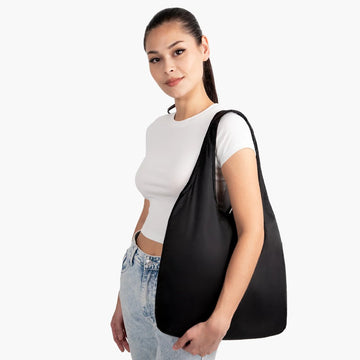
The 19L Sling weighs 0.90 oz and wears as a crossbody for hands-free carry.
The 14L Pack is a drawstring backpack at 0.95 oz for shorter rides and errands.
The 16L Daypack is a zippered backpack with a YKK closure at 1.15 oz for commuter cycling, day trips, and travel.
Every Nanobag sold funds the planting of one tree through Eden People + Planet.
The best reusable shopping bag for you is the one that matches how you actually shop, holds up to years of daily use, and stays with you between trips. Look for durable fabric like ripstop nylon, a published load rating you can rely on, reinforced construction at the stress points, and a packable design that fits how you carry the bag. Nanobag delivers all four across every model in the lineup, which is why one Nanobag can replace the drawer full of unused totes that most shoppers accumulate over the years.
Condividi:
Nylon vs Polyester: Which Fabric Is Better for Bags?