
- by Ursus Negenborn
What Is Ripstop Fabric? A Complete Guide
- by Ursus Negenborn
If you have ever felt the slightly textured surface of a tent, the smooth-but-tough feel of a packable jacket, or the surprising lightness of an ultralight bag, you have probably touched ultralight ripstop fabric without realizing what it was. So what is lightweight ripstop fabric, and why does it show up in everything from parachutes to grocery totes? The short answer is that ripstop is one of the most quietly important fabrics in modern textiles, engineered to stop tears in their tracks while staying light enough to carry anywhere.
This guide walks through what ripstop fabric is, how it works, the difference between standard ripstop and diamond ripstop, and where each one earns its place. By the end, you will know exactly what is keeping your gear from falling apart on the trail, in transit, or in daily use.
Ripstop fabric is a woven textile featuring a reinforced grid at regular intervals, designed to prevent tears from spreading. When the fabric experiences stress and a small tear starts, those reinforcement threads catch it. The tear runs to the next reinforcement line and stops there, rather than propagating across the entire fabric the way it would in a standard weave. This is the property that gives ripstop its name and its purpose: it stops rips.
You get the carrying properties of a lightweight base material with durability that approaches much heavier alternatives. This is why ripstop has become a default choice for gear that has to balance strength against weight.
Ripstop fabric was developed during World War II, when the United States military needed to replace silk parachutes. Silk had been the standard parachute material for decades, but the war disrupted the silk supply chain. The military, in partnership with textile manufacturers, developed nylon ripstop as a synthetic replacement. The reinforced grid weave proved more reliable and the new fabric quickly spread into military uniforms, equipment covers, and tents.
After the war, ripstop moved into civilian use. Outdoor gear manufacturers adopted it for tents, sleeping bags, and backpacks where weight and tear resistance both mattered. Aerial sports adopted it for kites, sails, and hot air balloons. By the late twentieth century, ripstop had become a standard outdoor and travel-gear fabric, with newer variants like diamond ripstop emerging for applications that needed even more performance.
The mechanics of ripstop come down to one principle: stop tears at the reinforcement line.
In a standard weave, when a tear starts, it can travel uninterrupted along the grain of the fabric. A small puncture in your tent or your bag can quickly become a large rip if the fabric is stressed. Ripstop interrupts this propagation with the reinforcement threads woven into the base. These thicker threads are stronger than the base material, so when a tear reaches one, the energy of the tear gets absorbed by the reinforcement rather than continuing through the fabric.
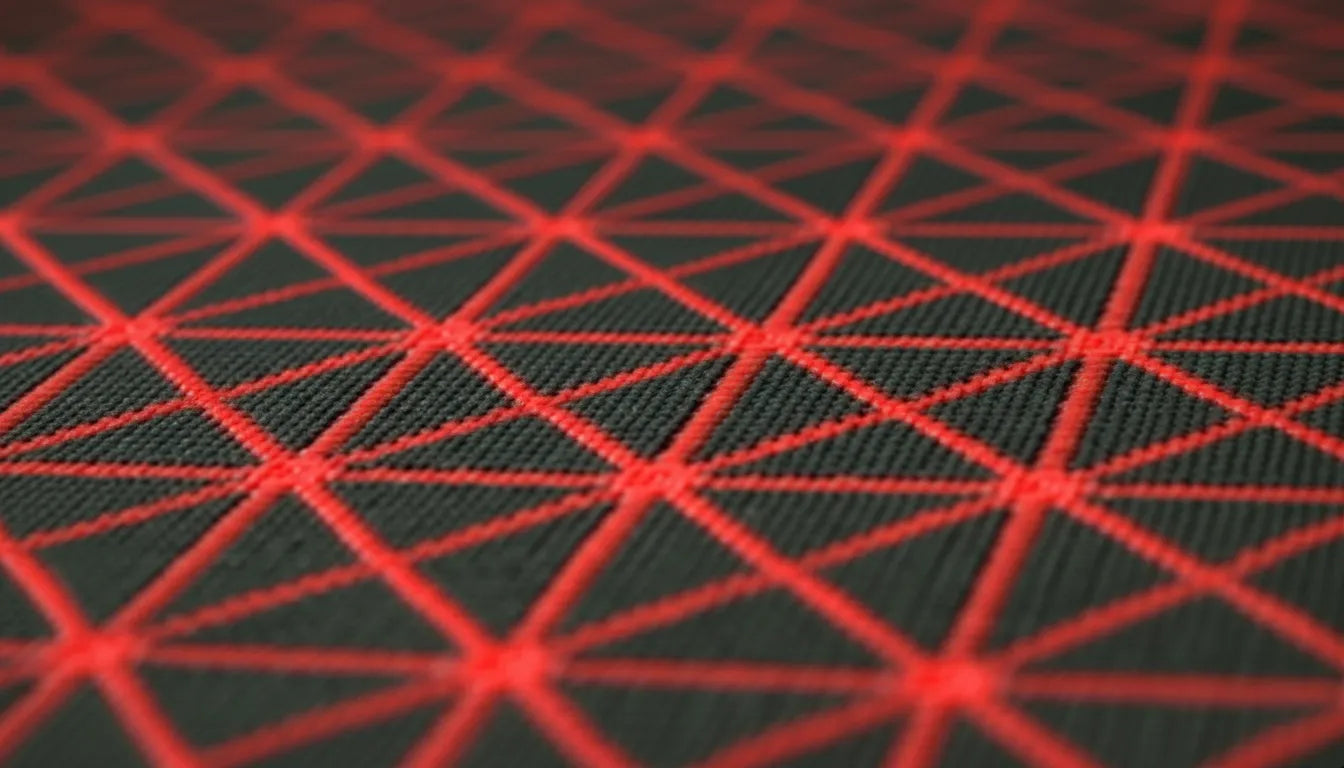
The pattern of these reinforcements matters. In a standard ripstop, they run perpendicular to each other in a simple grid. In a diamond ripstop, they run diagonally and intersect in diamond shapes. Both patterns work on the same principle, but the spacing and angle of the reinforcements affect how quickly a tear gets caught and how distributed the strength is across the fabric.
Standard ripstop uses a square grid of reinforcement threads. Two sets of reinforcements run perpendicular to each other, creating evenly spaced squares across the fabric. This is the most common form of ripstop and works well for general-purpose applications like tents, casual outdoor gear, and clothing.
Diamond ripstop uses reinforcements that intersect the rip stop squares at a 45 degree angle, creating an additional diamond shaped pattern. The reinforcement threads run diagonally, which means a tear has fewer paths to travel before hitting a reinforcement. The diamond pattern also distributes stress more evenly across the fabric.
In practical terms, diamond ripstop is generally considered to offer better tear resistance and a more uniform strength distribution than standard ripstop. The denser intersection points catch tears faster, and the angled pattern means the fabric stays strong in multiple directions rather than primarily along the grain. The trade-off is that diamond ripstop is typically more expensive to produce, because the weaving pattern is more complex and the reinforcement spacing requires more precision. For applications where weight, strength, and durability all matter, like high-performance gear, diamond ripstop is a premium option.
Ripstop fabric is one of the most widely used technical textiles in the world. You encounter it in more places than you probably realize.
Outdoor gear is the most familiar category. Tents, sleeping bags, hammocks, rain jackets, hiking pants, and packs of all sizes use ripstop because it handles weight, weather, and wear simultaneously.
Military and tactical applications continue to drive ripstop development. Uniforms, equipment covers, parachutes, and emergency gear use various weights of ripstop depending on the requirement.
Aerial and water sports use lightweight ripstop for kites, sails, hot air balloons, and parachuting equipment. The strength-to-weight ratio is critical when the fabric has to hold against wind or water pressure.
Travel gear and ultralight bags have become a growing category, particularly as travelers prioritize packability and weight. Packable jackets, foldable backpacks, and reusable bags increasingly use diamond ripstop because the same properties that make it work for parachutes make it ideal for gear that needs to fold down small and still hold a real load.

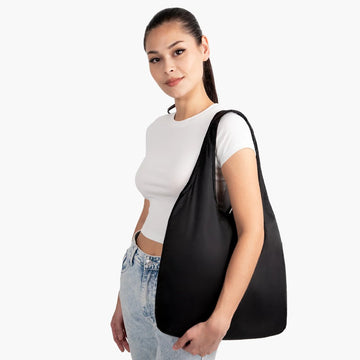
Nanobag builds its entire lineup from custom diamond ripstop, with the fabric engineered to a 0.05mm thickness across every model. That thinness is what allows the bags to fold down into a pocket-sized pouch, while the diamond ripstop construction is what allows them to carry up to 66 lb without tearing.
The fabric is also finished with a PFC-free water-repellent coating that sheds water rather than soaking it up. Pack Hacker's review tested this directly by running a Nanobag under a tap for thirty seconds and reported that the interior stayed largely dry. The combination of diamond ripstop construction and water-repellent finish is what allows a sub-one-ounce bag to handle grocery runs, travel days, and trail use without the failure points that bulkier alternatives carry.
Across the lineup, the bartack reinforcement at every stress point complements the diamond ripstop weave. Where the fabric would face the most concentrated load, like the handle attachment points, the construction is reinforced beyond what the weave alone provides. This is why a bag that weighs less than an ounce can carry a full grocery shop with ease. You can see the full lineup of bags made from this material in the Nanobag product range.
Ripstop fabric is one of those quiet engineering achievements that solved a real problem and never stopped being relevant. From parachutes to grocery bags, the principle has held for over eighty years: weave reinforcement threads through a lightweight base, and you get a fabric that is both light enough to carry anywhere and strong enough to take real wear.
Diamond ripstop refines that principle further, distributing strength more evenly and catching tears faster than standard versions. When you are choosing gear that needs to balance weight against durability, knowing the fabric is diamond ripstop tells you something real about how it will perform.
Share:
How to Choose the Best Day Hiking Backpack
Nanobag Featured in Pack Hacker's Travel Gear Review