- by Ursus Negenborn
How to Pick the Right Nanobag Size for Your Needs
- by Ursus Negenborn
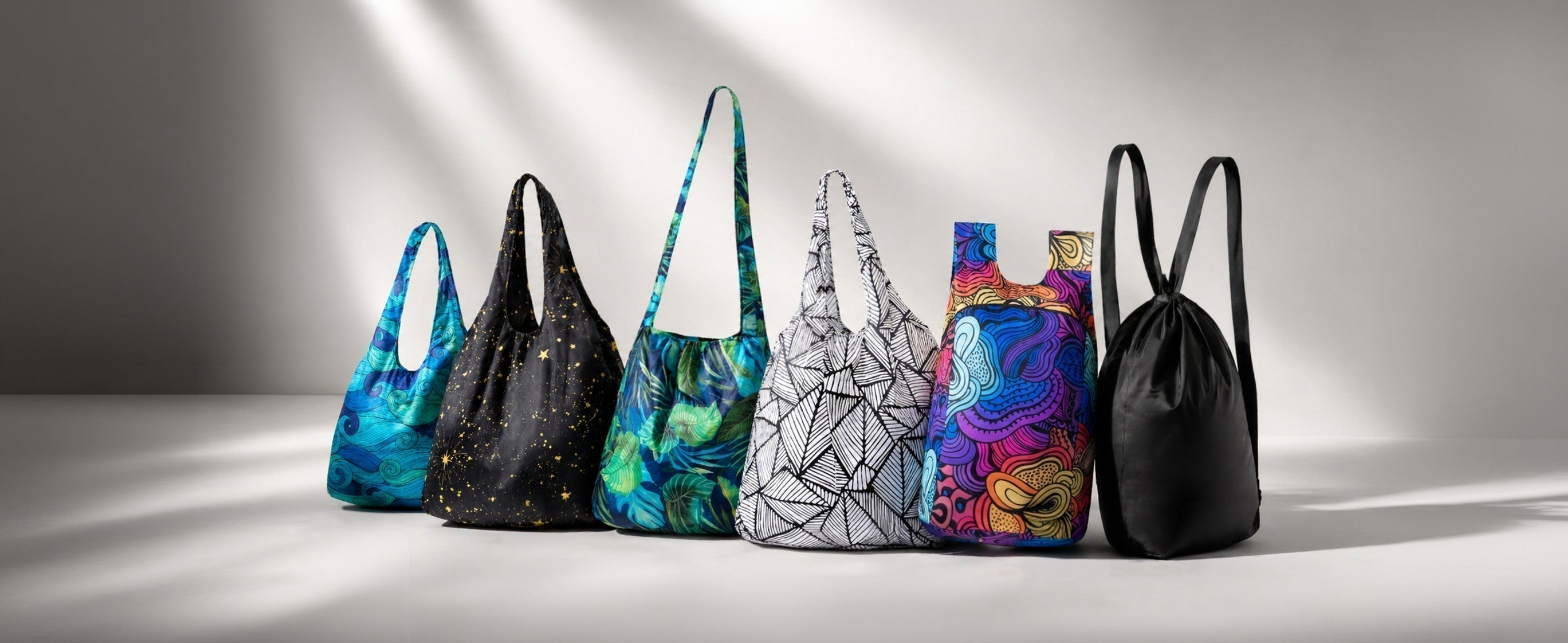
There are six Nanobag styles on the market right now: the Micro, the Standard, the Sling, the Pack, the XL, and the Daypack. Each one weighs somewhere between 0.80 oz and 1.15 oz. Each one folds to a thumb-sized bundle. And every single one of them carries up to 66 lbs. On paper, they sound nearly identical. In practice, they serve genuinely different purposes, and choosing the wrong one means you will use it less.
This guide walks through every current Nanobag style, explains what each one is actually built for, and tells you plainly which one to buy based on how you live.
All size and weight data in this guide is taken directly from the official Nanobag product page, which includes the full comparison table for all six models.
Before comparing models, it is worth understanding what the liter numbers mean in practice, because the figure alone tells you very little. Litre measurements refer to internal volume, not exterior dimensions, which makes them the most reliable way to compare carrying capacity across different bag styles.
As a practical reference: a quick corner shop run or daily essentials carry suits bags in the 10 to 14 liter range. Regular shopping trips benefit from 15 to 20 liters and larger hauls, full weekly shops, or beach days tend to need 25 liters or more. With that in mind, here is how the six Nanobag models stack up.
|
|
Micro |
Standard |
Sling |
Pack |
XL |
Daypack |
|
Style |
Tote |
Tote |
Crossbody |
Drawstring |
Tote |
Zippered BP |
|
Volume |
12L |
19L |
19L |
14L |
25L |
16L |
|
Weight |
0.80oz |
0.9oz |
0.9oz |
0.95oz |
1.05oz |
1.15oz |
|
Load cap. |
66 lbs. |
66 lbs. |
66 lbs. |
66 lbs. |
66 lbs. |
66 lbs. |
|
Size packed |
2.5x2x1" |
3x2x1" |
3x2x1" |
3.5x2x1" |
3.5x2x1" |
3.5x2x1" |
|
Unpacked |
13x12" |
17x16" |
17x16" |
14x19" |
20x17" |
14x18" |
|
Handle |
12" |
12" |
20" |
31" |
12" |
27" |
|
YKK zipper |
No |
No |
No |
No |
No |
Yes |
|
Tree planted |
Yes |
Yes |
Yes |
Yes |
Yes |
Yes |

Volume: 12L | Weight: 0.80 oz | Packed: 2.5" x 2" x 1" | Unpacked: 13" x 12"
At 0.80 oz, the Micro is the lightest Nanobag made, and at 12 liters it is also the smallest in volume.
It is the one to choose if you already carry a small bag or purse and want a secondary option that adds absolutely nothing to your load. Its packed dimensions of 2.5 x 2 x 1 inches mean it genuinely disappears. For people who walk to a corner shop a few times a week and want to skip the plastic bag at the checkout, the Micro is purpose-built for exactly that scenario.
Where it falls short is capacity. If you shop for more than a handful of items, or if you tend to pick up larger bottles or produce, the Micro can feel limiting.
Best for: Minimalist EDC, daily essentials, corner shop runs, travel backup bag, petite carry preference.
Not ideal for: Full grocery shops, or carrying anything bulky, or hands-free use.

Volume: 19L | Weight: 0.90 oz | Packed: 3" x 2" x 1" | Unpacked: 17" x 16"
The Standard is the original Nanobag and still the one most people should buy first. At 19 liters and 0.90 oz, it covers the majority of daily use cases without adding perceptible weight to your pocket or bag. The 17 x 16 inch footprint when open is generous enough for a mid-size grocery shop, a farmers market haul, or general errands.
Pack Hacker's Nanobag review confirms the Standard is well suited to trips to local farmers markets, and equally useful for managing laundry when traveling. Beyond that, it covers the widest range of everyday tasks without specializing too much in any direction, which is exactly why it's the best starting point for anyone new to Nanobag.
The handle length of 12 inches means it works best carried by hand or over the shoulder.
Best for: Grocery runs, farmers markets, everyday errands, travel secondary bag, first-time Nanobag buyer.
Not ideal for: Very large shops or hands-free use.

Volume: 19L | Weight: 0.90 oz | Packed: 3" x 2" x 1" | Unpacked: 17" x 16" | Strap: 20"
The Sling has the same volume and weight as the Standard, and the same packed dimensions. The difference is entirely in the carry system. Instead of two handles, the Sling has a single 20-inch tall reinforced strap designed to be worn over the shoulder or across the body. This changes the bag entirely for certain types of use.
Pack Hacker's review notes that the Sling's strap is slightly thicker than the Standard's handles, which spreads weight across a wider surface area for a more comfortable carry, especially when dealing with heavier loads over longer distances. The hands-free design makes it the go-to for cyclists, city commuters, and anyone who wants both hands free without switching to a full backpack.
Nanobag owners who travel frequently consistently cite the Sling as their most-reached-for bag for airport terminals, street markets, and city exploration, precisely because it keeps hands free without adding bulk.
Best for: City commuting, cycling, longer walks, travel, markets, hands-free daily carry.
Not ideal for: Very large shops. If you prefer a closed design.

Volume: 14L | Weight: 0.95 oz | Packed: 3.5" x 2" x 1" | Unpacked: 14" x 19" | Drawstring: 31"
The Pack is the most distinct style in the range. It is the only model that carries on your back using a drawstring closure, which means both hands are completely free. At 14 liters it is the smallest by volume after the Micro, but the backpack carry style makes it feel more capable for active use than the numbers suggest.
At 0.95 oz it is heavier than the Standard and Sling, and at 3.5 x 2 x 1 inches it packs slightly larger, but it remains genuinely pocket-sized. The drawstring closure also means the contents are more secure than any of the open tote styles.
The Pack is the natural choice for gym sessions, cycling, hiking day trips, or any activity where you want your hands completely free and your bag secured on your back. It’s also perfect for carrying rackets, as they can stick out through the opening, while the bag remains closed. The 14 x 19 inch open dimensions make it taller than wide, which fits well with a backpack-style load of water bottles, gym clothes, or lightweight gear. It also works well for carrying sports rackets, since the drawstring top allows long handles to protrude while the bag stays closed around them.
For heavier loads, we do recommend the Daypack, as it has wider handles, but for light loads, the Pack is perfect.
Best for: Gym, cycling, hiking, active sports, hands-free carry, racket sports.
Not ideal for: Heavy loads, Big shopping.

Volume: 25L | Weight: 1.05 oz | Packed: 3.5" x 2" x 1" | Unpacked: 20" x 17"
The XL is the largest tote in the range at 25 liters and 20 x 17 inches when open. That puts it firmly in the territory of full weekly grocery shops, large farmers market hauls, and warehouse store runs, situations where any of the other tote styles would require multiple trips or feel genuinely under-sized.
Despite being the largest tote, it weighs only 1.05 oz and packs to 3.5 x 2 x 1 inches, which is barely distinguishable from the Standard when folded. The 12-inch handles are the same length as the Standard, so the carry experience is pretty much the same. What changes is how much the bag can hold once open.
The XL is also frequently chosen as a travel overflow bag for souvenirs, market finds, or airport purchases. If the Standard is your first Nanobag and you find yourself wishing it were larger, the XL is the direct upgrade.
Best for: Full weekly grocery shop, farmers market, large hauls, travel overflow, bulk buying.
Not ideal for: Minimalist carry or situations where you want the smallest possible bag.

Volume: 16L | Weight: 1.15 oz | Packed: 3.5" x 2" x 1" | Unpacked: 14" x 18" | YKK zipper: Yes
The Daypack is the most feature-rich model in the range and the only one with a full YKK zipper closure. At 1.15 oz it is the heaviest Nanobag, though that number still places it well below almost any comparable packable backpack on the market. The 16 liter volume and wide backpack straps make it the go-to choice for a full day out.
The YKK zipper is the primary reason to choose the Daypack over the Pack. It means the contents are fully secured, which matters for travel, commuting, or any situation where you want to keep items from shifting or falling out. The wide straps distribute weight more evenly across your shoulders than a drawstring, making a real difference over a long day of walking, sightseeing, or commuting.
At 16 liters, the Daypack is well-matched to a day of walking, sightseeing, commuting, or light hiking where you want the security of a zipper and the comfort of its wide straps for comfortable carry.
Best for: Day trips, travel, commuting, hiking, securing valuables, anyone who wants a zippered close.
Not ideal for: Quick errand runs where you want instant open access, or minimalist pocket carry.
Use this as a direct reference if you do not want to read every section above.
|
Your situation |
Choose |
|
I want the lightest bag |
Micro |
|
I need a bag for daily errands and grocery runs |
Standard |
|
Cycling and hiking |
Daypack or Pack |
|
Gym or racket sports |
Pack |
|
I do a full weekly grocery shop or big hauls |
XL |
|
I want a zippered bag with wider straps |
Daypack |
|
I want a bag I can carry on both shoulder and by hand |
Standard. XL or Micro |
|
I prefer a crossbody bag with an extra wide strap for hands free carry |
Sling |
Regardless of which size and style you choose, every Nanobag is made from the same custom diamond ripstop nylon fabric with a PFC-free water-repellent coating. They are all designed so no elaborate folding is needed. The fabric naturally eliminates air pockets, so you can just stuff it in your pocket or the attached pouch and it'll practically disappear. All our bags are made to be carried with ease, all day, every day.
All models use bartack stitching at the primary stress points and are rated to carry up to 66 lbs. Every bag folds into an attached integrated pouch so you can never lose it, and no folding technique is required. Just stuff it in.
All six models come in a range of designs from solid colors to patterns, and every purchase plants a tree through Eden People + Planet.
Share:
The Ultimate Packing Light Guide for Carry-On Only Travel
The Best Travel Gifts for Frequent Flyers in 2026