

- by Ursus Negenborn
How Much Weight Can Reusable Bags Hold? A Realistic Answer
- by Ursus Negenborn
The honest answer is that reusable bags range widely in what they can carry, from around 15 lb (7 kg) for thin polyester foldables to well over 60 lb (27 kg) for engineered ripstop nylon bags with reinforced construction. The difference comes down to fabric, weave, stitching, and how the handles attach to the body of the bag.
Most shoppers never test the upper limit of their reusable bag, but the number matters. A bag that fails at the checkout counter with a full grocery load creates a real problem, and the fix is picking a bag with a load rating that actually fits how you use it.
Four things decide how much weight a reusable bag can carry safely: the fabric, the weave pattern, the reinforcement stitching at stress points, and how the handles attach to the body of the bag. Weakness in any one of these four is what causes a bag to fail.
The fabric provides the base tensile strength. Different materials have very different strength-to-weight ratios. The weave pattern determines how well the fabric resists tearing under load; a fabric that tears easily fails long before its actual tensile limit. The reinforcement stitching at handle attachments, base corners, and seam terminations handles the concentrated stress points where most bags fail first. And the handle attachment method determines whether the straps can carry the full load or come loose from the body of the bag under weight.
A bag can have strong fabric and still fail if the handles are stitched on with regular thread rather than reinforced with bartack stitching. This is why the published load rating of a well-made bag matters more than the material alone.
Different materials carry very different amounts of weight. These are realistic figures for well-made bags of each type.
A standard cotton canvas tote handles moderate grocery loads. Higher-quality canvas with double-stitched seams reaches the upper end of the range. Cotton absorbs water, which reduces safe capacity when the load is wet or the fabric is damp from a previous trip.
Jute is naturally strong and holds heavy loads well when the weave is dense. The fabric is bulky and does not compress, so a jute bag takes up real space in a car or drawer between uses, and it holds moisture longer than most other materials.
Most inexpensive polyester grocery bags handle typical shopping loads but sit at the lower end of the load range. Thin plain-weave polyester tears at concentrated stress points, and lightweight thread at the handle attachment is the most common failure point.
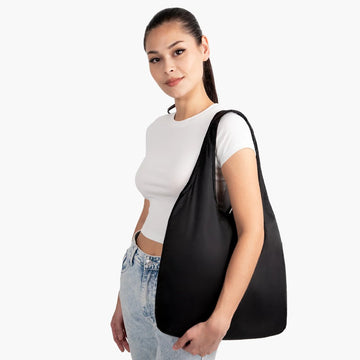
Ripstop nylon combines a strong synthetic fiber with a weave pattern designed to stop tears from spreading. The result is one of the highest strength-to-weight ratios available in reusable bags, and the reason ripstop nylon has become the format of choice for engineered packable bags. The Nanobag lineup uses custom diamond ripstop nylon with a 66 lb (30 kg) load rating across every model, from the 12L Micro through the 25L XL. That load rating comes in bags weighing less than an ounce empty, which no other reusable bag material can match at the same weight class.
The 66 lb load rating on every Nanobag comes from four engineering choices working together.
The first is the fabric itself: custom diamond ripstop nylon, 0.05mm thick, with a diamond weave pattern that stops small tears from spreading across the fabric. You can read more about how the weave works in the guide to diamond ripstop fabric.
The second is bartack reinforcement at every stress point. Handle attachments, base seams, and zipper terminations all carry dense bartack stitching that distributes load across dozens of stitches rather than a few. Details on how the technique works are in the bartack stitching guide.
The third is the handle geometry. Wide, well-designed straps spread load across the shoulder or hand rather than concentrating it, which reduces the pressure at any single point on the bag. The fourth is double-stitched piping along the seams, which reinforces the bag's structural edges where the fabric would otherwise stretch or tear under a full load.
The result is a bag that weighs less than an ounce in the lightest models and still carries 66 lb without straining. That combination of ultralight construction and heavy load capacity is what separates a well-engineered ripstop nylon bag from a generic packable tote.
Not every bag lists a load rating, and marketing copy is often vague. Three things tell you whether a bag can actually carry what it claims, and looking at these three points is the fastest way to separate a bag that will hold up from one that will fail.
Look at the handle attachment points first. Reinforced stitching, visible as a dense rectangle or box pattern where the straps meet the body, is what carries the real load. Straps stitched on with a single row of thread are the first thing to fail. Every Nanobag uses bartack reinforcement at every handle attachment, which is why the load rating holds across the full lineup.
Check the seam construction next. Double-stitched or reinforced seams handle load better than single-stitched seams, and piping along the base and edges adds structural strength that a plain seam cannot match. Nanobag uses double-stitched piping along every seam and reinforced construction at every base corner.
Finally, look for a published load rating from the brand. Bags without a rating are usually rated for light-to-moderate loads only, regardless of what the fabric might technically handle. Nanobag publishes a 66 lb (30 kg) load rating across every model, which means the same figure applies whether you carry the 12L Micro or the 25L XL.
A bag warns you before it fails. Small signs to watch for: stitches loosening at the handle attachment, fabric stretching visibly around the base corners, or the handle straps deforming under weight rather than staying flat. Any of these means the bag is being loaded beyond its safe capacity.
If you regularly load a bag past its rated capacity, the handles will eventually pull loose from the body. This is the most common failure mode for reusable bags, and it usually happens without warning at the least convenient moment. Choosing a bag with a load rating well above your typical use gives you a real safety margin.
For daily use, the practical choice is a bag that combines the highest load capacity with the lightest empty weight, because that combination is what makes a reusable bag actually get used every day.
This is where Nanobag stands apart. Every model in the lineup carries 66 lb (30 kg) while weighing less than an ounce empty, and the entire bag folds into a pocket-sized pouch when not in use. Cotton and polyester bags cover light errands, but for daily use across full grocery runs, farmers markets, and unplanned pickups, ultralight ripstop nylon is the format that holds up without asking for space in your bag or car.
Share:
What Is Bartack Stitching and Why It Matters
Ripstop Nylon vs Cotton: Which Lasts Longer?