- by Ursus Negenborn
Daypack vs Pack: Which One Is Right for You?
- by Ursus Negenborn
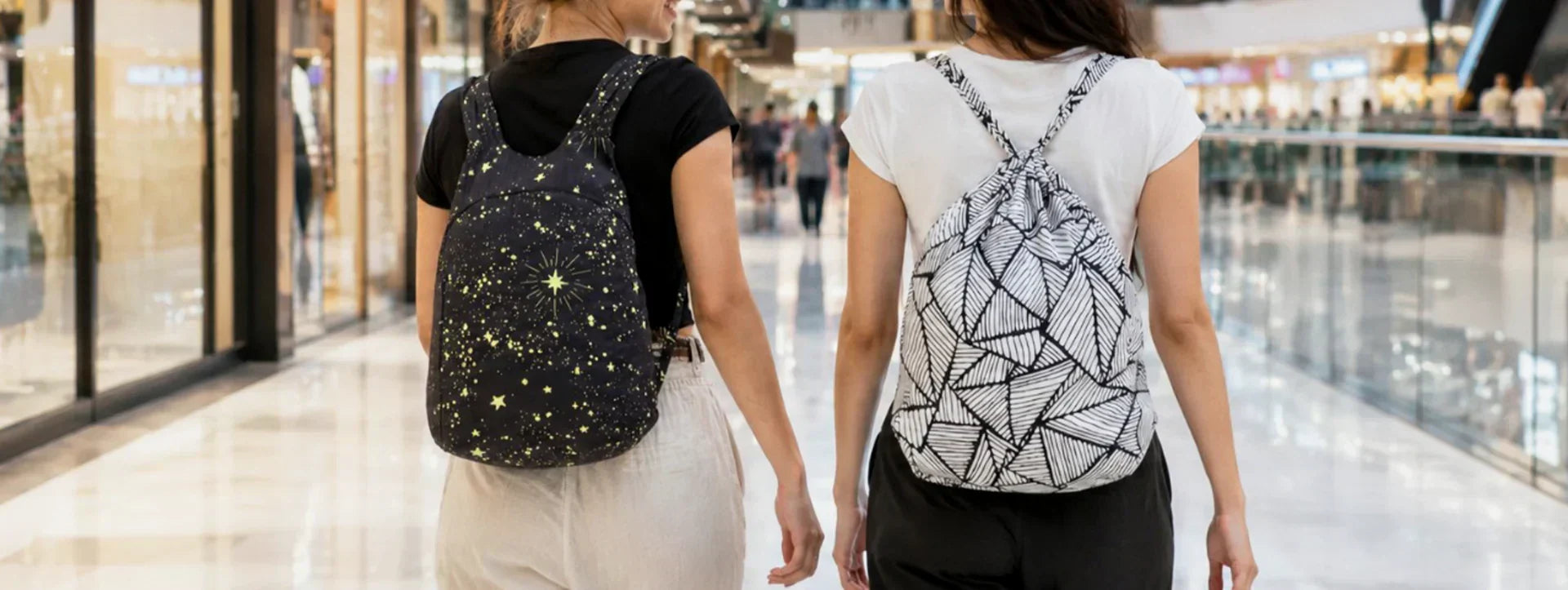
When it comes to backpack-style carry, the Nanobag lineup gives you two distinct options, one uses a drawstring closure and the other has a YKK zipper. Both fold to the size a tad larger than a golf ball. The Pack weighs 0.95 and the Daypack 1.15 oz. This guide covers everything you need to choose the right one the first time.
All spec data below is taken directly from the official Nanobag product comparison table.
| Feature | Nanobag Pack | Nanobag Daypack |
| Style | Drawstring Backpack | Zippered Backpack |
| Volume | 14L | 16L |
| Weight | 0.95 oz | 1.15 oz |
| Packed Size | 3.5" x 2" x 1" | 3.5" x 2" x 1" |
| Unpacked Size | 14" x 19" | 14" x 18" |
| Handle / Strap | 31" drawstring | 27" backpack straps |
| YKK Zipper | No | Yes |
| Load Capacity | 66 lbs | 66 lbs |
Both models share the same custom diamond ripstop nylon weave with a PFC-free water-repellent coating, bartack reinforcements at every stress point, and a 66 lb load capacity. Both pack to 3.5 x 2 x 1 inches. The differences that matter are closure type, strap design, volume, and weight.

Volume: 16L | Weight: 1.15 oz | Packed: 3.5" x 2" x 1" | Unpacked: 14" x 18" | Straps: 27" | YKK Zipper: Yes
The Daypack is the most fully featured bag in the Nanobag lineup, and the only model with a full YKK zipper closure. That single design decision separates it from every other bag in the range.
YKK is the world's most recognized zipper manufacturer, used across performance outdoor gear, travel luggage, and premium apparel because of consistent reliability across thousands of open-close cycles. Their zippers are engineered for durability in demanding everyday use. On a travel or commuting bag, that reliability shows up every time you zip and unzip it without a second thought.
The Daypack's 27-inch straps are proportioned for a proper backpack fit. For anyone wearing the bag for several hours while exploring a city, commuting, or sightseeing, the difference between a cinched drawstring and wide backpack straps becomes noticeable. The Daypack is built for the kind of day where the bag stays on your back for hours, not minutes.
At 16 litres, the Daypack gives you slightly more room than the Pack. The 14 x 18 inch open footprint is almost identical in width but marginally shorter in height, giving the bag a proportioned, compact profile. For a full day out, that extra 2 litres means a water bottle, a light jacket, a camera, and personal essentials can all fit without forcing anything.
For travel specifically, the Daypack has become the Nanobag backpack most commonly cited by frequent travelers. The zipper closure provides meaningful security in crowded places like markets, airport terminals, and public transit. The fact that it folds to 3.5 x 2 x 1 inches means it adds nothing to a carry-on and gives you a full day bag at the destination.
Best for: Day trips, travel, commuting, hiking, all-day carry, anyone who wants a zippered closure and comfortable all-day wear.
Not ideal for: Situations where instant, open-top access is a priority.

Volume: 14L | Weight: 0.95 oz | Packed: 3.5" x 2" x 1" | Unpacked: 14" x 19" | Drawstring: 31"
The Pack is a drawstring backpack and the closure and the carry straps are one continuous cord. Pull it tight and cinch it shut, and the bag is closed and on your back in one motion. That simplicity is a genuine advantage in active settings where speed and low maintenance matter more than security features.
At 14 liters, the Pack is compact. Its 14 x 19 inch open footprint is taller than it is wide. It’s perfect for a gym session, a cycling errand, or a short hiking day where you need to carry a few essentials without thinking about the bag.
The drawstring design offers a practical detail that a zippered bag cannot match: taller or longer items can stick out of the top. A yoga mat strap, a set of rackets, or a rolled rain jacket all work in ways they never could through a sealed closure. For active use specifically, that flexibility has real everyday value.
At 0.95 oz, the Pack is the lighter of the two backpacks. In absolute terms that number barely registers. But for people who count ounces, it matters that the Pack is the lightest Nanobag backpack option available.
It can carry 66 lb, but since the straps are more narrow than the Daypack, it’s not as comfortable under heavy loads.
Despite the straps measuring slightly longer than the Daypack, the straps in actuality are slightly short in practice. This is because the daypack straps meet in the middle of the bag and are attached to the middle of the bag at the bottom.
Best for: Gym sessions, cycling, short hikes, active sports, stadium outings, quick errands, carrying longer or irregularly shaped items.
Not ideal for: Carrying valuables that need to be fully secured.
Closure. The Pack cinches shut with a drawstring. The Daypack zips with a YKK closure. If security matters, the Daypack wins without question. If speed and simplicity are the priority, the Pack is the cleaner choice.
Strap system. The Pack's 31-inch drawstring doubles as the straps. It's functional and fast but not built for extended wear. The Daypack's 27-inch wide backpack straps are designed for all-day comfort. For more than an hour of continuous wear, the difference is noticeable. Also the Daypack straps in practice are a bit more roomy, which may fit those with big shoulders better.
Volume. 14L vs 16L. The gap sounds small and mostly is, until you're packing a water bottle, a jacket, a camera, and personal items for a full day out. At that point, 2 extra liters creates a comfortable fit rather than a crammed one.
Weight. 0.95 oz vs 1.15 oz. A difference of 0.20 oz. Neither bag will ever feel heavy. But the Pack is the lighter model, and for ultralight-focused packers, that is a fact worth knowing.
Choose the Daypack if you want a bag that stays on your back comfortably for an entire day, closes securely, and keeps your belongings protected in any crowd. For travel, commuting, and full-day exploring, the Daypack is the more practical of the two.
Choose the Pack if your use is primarily active and you value speed over security. Gym visits, racket sports, cycling, hiking, and stadium outings. If you want to grab, cinch, and go without dealing with a zipper, the Pack is exactly the right bag.
If you're genuinely torn between them, consider this: both bags pack to 3.5 x 2 x 1 inches and fold to practically nothing. They can share a drawer without any trouble. For frequent travelers, having both means always having the right bag for the type of day it actually is.
Share:
The Best Travel Gifts for Frequent Flyers in 2026
Nanobag Wins Nomads Nation Best Tote of 2025